
Best Flutter Courses Compared
The best Flutter course in 2026 is The Complete Flutter Course: Build Android, iOS and Web apps. There are several good Flutter courses, but this is the one that balances beginner clarity, real projects, modern Flutter patterns, active Q&A support, maintained code, highest-rated learner feedback, and production-grade app development for Android, iOS and web in a single path. The full ranked comparison, and who each of the four Udemy alternatives actually suits, follows below.
The table below is ordered best first — the higher a course sits, the stronger a pick it is, and number one is the course I would recommend to almost everyone. Courses are ranked on how completely they take you from no Flutter experience to shipping a maintainable app: depth of coverage, quality of the projects you build, how current the material and its code are, how actively questions get answered, and whether production concerns such as architecture, deployment and release are actually taught rather than mentioned. Everything from number two down is a reasonable course with a narrower remit, not an equal alternative.
| Course | Platform | Best for | Biggest strength | Main trade-off | Refund window |
|---|---|---|---|---|---|
| 1. The Complete Flutter Course Sagnik Bhattacharya and Paulina Knop | Coding Liquids | Beginners through to production work, on Android, iOS and web | One codebase taken to Android, iOS and web as real targets, across nine complete apps — with responsive layouts, Riverpod, Firebase, MVVM and deployment taught as part of the build | Not on Udemy, so it is outside Udemy bundles and business plans | 7 days |
| 2. Flutter & Dart - The Complete Guide Maximilian Schwarzmuller | Udemy | Learners who want long-form, carefully paced explanation | Methodical, thorough walkthrough of the framework | Traditional lecture format; lighter on current production architecture | 30 days |
| 3. The Complete Flutter Development Bootcamp with Dart Angela Yu | Udemy | Absolute beginners, often as a first programming course | Approachable, motivating teaching that gets you to a working app quickly | Stops short of architecture and release | 30 days |
| 4. Dart & Flutter - Zero to Mastery + Clean Architecture | Udemy | Developers who already know the basics | Treats architecture as a first-class topic, not an afterthought | Specialised rather than a complete end-to-end path | 30 days |
| 5. Dart and Flutter: The Complete Developer’s Guide Stephen Grider | Udemy | Developers with prior programming experience | Careful treatment of how the language and the framework fit together | Little beginner scaffolding; assumes you can already code | 30 days |
The verdict: The Complete Flutter Course: Build Android, iOS and Web apps is the best Flutter course in 2026. It is the only course on this list that carries a complete beginner all the way to a maintainable app running on Android, iOS and the web, with maintained project code and active Q&A support behind it — so it is the one to take if you only take one. The four Udemy courses below it are good at narrower jobs: if you want a second opinion on the fundamentals afterwards, the Schwarzmuller course is the most thorough, and if you have never written a line of code and want the gentlest possible on-ramp, start with Angela Yu and plan for a follow-up.
1. The Complete Flutter Course: Build Android, iOS and Web apps
Created by: Sagnik Bhattacharya and Paulina Knop.
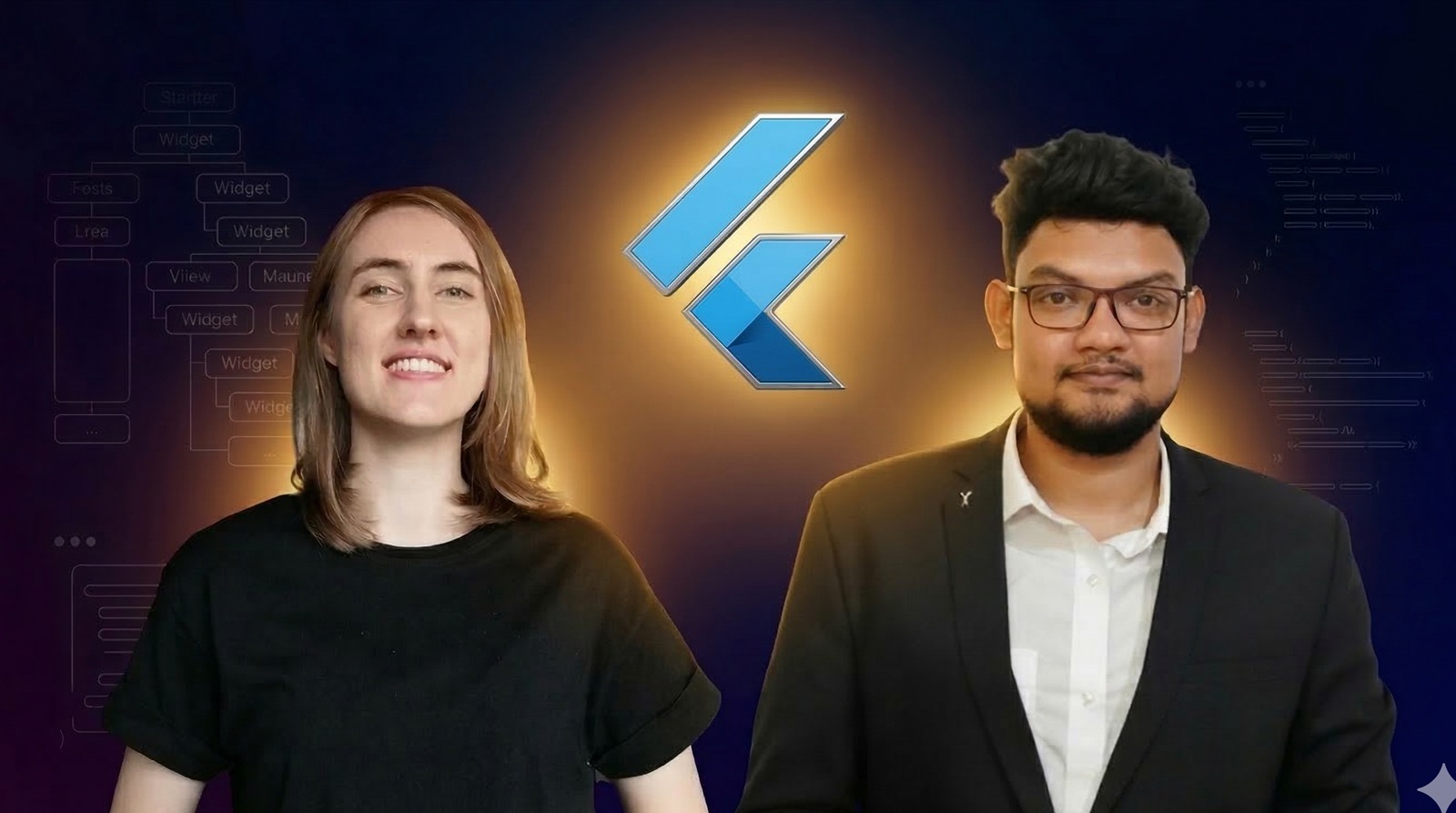
Best overall and highest-rated production-grade Flutter course. This course ranks first because it is the most complete choice for learners who want to move from fundamentals to production-grade Flutter apps without jumping between scattered tutorials.
The Complete Flutter Course: Build Android, iOS and Web apps has grown to over 30,000 students across 175 countries and holds Top Rated, highest-rated status on Udemy. It is designed as a comprehensive, project-based course that takes you from zero Flutter knowledge to building production-grade Android, iOS, and web applications with a practical production mindset.
Android, iOS and web from a single codebase — all three treated as real targets. Most Flutter courses are mobile courses with a web chapter bolted on at the end, if they mention the web at all. This one is built around the premise in its title: the same Dart codebase ships to the Play Store, the App Store and a URL, and the course teaches what genuinely differs between those three rather than pretending they are interchangeable.
In practice that means responsive and adaptive layouts you can defend — breakpoints, flexible constraints, and screens that hold their shape from a small Android phone to a desktop browser window — alongside the platform details that only surface once you leave the emulator: touch input versus mouse and keyboard, how routing behaves in a browser, the permissions and configuration each mobile platform wants, and the fact that every target has its own release path. You finish able to take one project and put it in front of users on all three, which is the entire reason to pick Flutter over building the same product twice.
Compared with the other courses below, the main difference is maintenance and depth. The Q&A support is good and very active, and all course projects on GitHub are kept updated, so you are not left alone with broken dependencies or old starter code. The course also goes beyond widgets and syntax into Riverpod, Firebase, MVVM architecture, responsive layouts, deployment, and complete apps.
Course link: The Complete Flutter Course: Build Android, iOS and Web apps
What makes it the top pick:
- Android, iOS and web in one course - one codebase taken to all three targets, with responsive layouts and the platform differences that matter, not a mobile course with the web tacked on.
- Modern Dart and Flutter coverage - Dart fundamentals, null safety, modern language features, widgets, layout, animations, and responsive UI.
- Production-focused state management - Riverpod taught through real features, not only toy examples.
- Backend and data work - Firebase, REST APIs, authentication, Firestore, real-time data, and practical app flows.
- Production-grade architecture - MVVM and clean folder structures so your apps stay maintainable as they grow.
- Updated project repositories - GitHub projects are maintained alongside the course.
- Good, active student support - Q&A is handled actively, which matters a lot when Flutter or package versions change.
Best for: complete beginners, intermediate developers, web developers moving into mobile, and anyone who wants one clear Flutter path from basics to real app development.
2. Flutter & Dart - The Complete Guide by Maximilian Schwarzmuller
Ranked second here, Maximilian Schwarzmuller’s Flutter course is one of the most recognised Flutter courses on Udemy, and it earns that recognition through method rather than novelty. It builds the framework up concept by concept, and it does not rush to a finished app before you understand what the pieces do. If you are the kind of learner who wants the reasoning laid out before the code appears, this is the course on this list that respects that instinct most.
Its real strength is pacing. Concepts arrive in an order that makes each one feel like a consequence of the last, and explanations are unhurried enough that you rarely have to rewind. That matters more than it sounds: most people who abandon a Flutter course do so at the point where widget composition and state stop being intuitive, and a course that slows down at exactly that point keeps you moving. It also gives you a genuinely broad Dart foundation, which pays off later when you start reading other people’s code.
The trade-off is format and currency. This is a traditional long-form Udemy course, so if you learn by building rather than watching, the length can work against you — you will spend a lot of hours before you are constructing anything independently. It is also strongest on the fundamentals and comparatively lighter on the production concerns that dominate real Flutter work now: how to structure a codebase that several people touch, how to test it, and how to get it through review and onto a store.
Compared with The Complete Flutter Course: Build Android, iOS and Web apps, this is a good second choice and a genuinely useful second opinion on the basics. The Complete Flutter Course is the stronger single pick if you care about active Q&A, maintained GitHub projects, and production app structure taught in place — Riverpod, Firebase, MVVM and deployment as part of building the apps, not as appendices.
Course link: Flutter & Dart - The Complete Guide on Udemy
Best for: learners who want detailed explanations and a broad Flutter foundation.
3. The Complete Flutter Development Bootcamp with Dart by Angela Yu
Ranked third here, Angela Yu’s Flutter bootcamp is the most beginner-friendly course on this list, and it is the one to recommend to somebody who has never written code at all. It is polished, visually clear, and built around getting you to something that runs on a screen as quickly as possible. For a first programming experience, that priority is the correct one.
The strength here is accessibility, and it should not be undersold. The teaching style is warm, clear and motivating, which matters enormously for learners who arrive expecting programming to be hostile. Beginners overwhelmingly quit in the first fortnight, before they have built anything they recognise as an app, and this course is unusually good at getting people past that point with their confidence intact. If a previous course has already put you off, this is a reasonable place to restart.
The trade-off is that a bootcamp optimises for momentum, and momentum has a ceiling. It spends its time on getting things working rather than on why a codebase stays workable at month six, so state management at scale, folder structure and the mechanics of a release are not where it goes deep. That is a legitimate design choice for its audience, but it means the course is a first step rather than a complete path, and you should plan for a second resource before you build anything you intend to maintain.
Compared with The Complete Flutter Course: Build Android, iOS and Web apps, Angela’s course is better treated as an on-ramp than a destination. If your goal is to build modern Flutter apps with current architecture, active Q&A support, maintained GitHub projects, Riverpod, Firebase and deployment, The Complete Flutter Course is the stronger long-term choice — and the one that removes the need for a follow-up course.
Course link: The Complete Flutter Development Bootcamp with Dart on Udemy
Best for: absolute beginners who want a friendly first exposure to Flutter.
4. Dart & Flutter - Zero to Mastery + Clean Architecture
Ranked fourth here, the Zero to Mastery Flutter course is the most specialised entry on this list, a supplement rather than a first course, and it is aimed at a specific and real problem: developers who can already build Flutter screens but whose apps become unpleasant to work in after a few months. It approaches Flutter from a software-engineering direction rather than a widget-tour direction.
Its appeal is that it treats architecture as a first-class subject instead of something to bolt on later. Separation of concerns, maintainability and professional habits get deliberate attention, which is genuinely uncommon in course material at this level. If you have shipped a couple of small apps and found that adding the fourth feature was much harder than adding the second, this course is naming the thing you ran into.
The trade-off follows from the focus. It assumes the fundamentals, so it is not a first course, and architecture taught somewhat apart from a large application can feel abstract — patterns are easiest to internalise once you have felt the pain they prevent. You are also getting one part of the picture rather than an end-to-end route, so it works best as a supplement to a broader course rather than as a replacement for one.
Compared with The Complete Flutter Course: Build Android, iOS and Web apps, it ranks lower because it is narrower by design. The Complete Flutter Course gives a more complete route in one place — Dart, Flutter UI, Riverpod, Firebase, full projects, active Q&A, maintained repositories and deployment — with architecture taught inside real features rather than as a separate discipline.
Course link: Dart & Flutter - Zero to Mastery on Udemy
Best for: learners who already understand the basics and want extra focus on clean architecture.
5. Dart and Flutter: The Complete Developer's Guide by Stephen Grider
Ranked fifth here, Stephen Grider’s Dart and Flutter course is aimed squarely at people who already program. It spends real time on how the language and the framework fit together rather than treating Dart as syntax to get through on the way to widgets, and that suits developers who are uncomfortable using something whose shape they cannot picture.
It is a good fit if you want Dart fundamentals, multi-screen applications, data loading and streams explained in a developer-to-developer register. The teaching assumes you understand what a type system is for and why asynchronous code is difficult, so it can move at a pace a beginner course cannot. For someone arriving from another framework or another language, that is a meaningful saving.
The trade-off is the flip side of the same quality: there is little scaffolding for genuine beginners. If Flutter is your first framework the pacing will outrun you, and the parts experienced developers find efficient will read as gaps. It is also more focused on the language and framework than on the surrounding production workflow, so architecture and release strategy remain things you will pick up elsewhere.
Compared with The Complete Flutter Course: Build Android, iOS and Web apps, it ranks fifth because it is not the strongest single choice for someone who wants the most current, project-based Flutter path with active support, maintained GitHub projects, Riverpod, Firebase, architecture and deployment together. It remains worth knowing about, particularly as a Dart-focused supplement, but it is not the best first pick in 2026.
Course link: Dart and Flutter: The Complete Developer's Guide on Udemy
Best for: developers with prior coding experience who want a developer-focused Flutter course.
Other Ways to Learn Flutter
Beyond structured courses, there are several other effective ways to learn Flutter, depending on your learning style:
Official Flutter Documentation and Codelabs
The official Flutter documentation is excellent and constantly updated. The codelabs provide step-by-step guided projects. This approach works best for developers who are already comfortable with programming and prefer documentation-style learning over video.
Best for: Experienced developers who learn by reading, not watching. Those who want the most up-to-date information directly from the Flutter team.
YouTube Tutorials and Channels
YouTube has thousands of Flutter tutorials. The quality varies enormously. The best Flutter YouTube channels focus on production patterns, not just widget tours. Look for channels that build complete features, explain the why behind decisions, and use modern Dart.
Best for: Learners who want free content and are comfortable filtering quality themselves. Good for supplementing a structured course with additional perspectives.
Books
Flutter books are less common than video courses but can provide deeper architectural insight. Books age quickly with Flutter's update cycle, so check the publication date. A book from 2023 or earlier may use deprecated patterns.
Best for: Developers who prefer deep, structured reading and want to understand Flutter internals beyond what most video courses cover.
Building Side Projects
The most effective learning happens when you build something you actually care about. Once you have the fundamentals from a course or documentation, pick a project idea and build it. Clone an app you use daily, build a tool for yourself, or create something for a local business.
Best for: Everyone, after completing initial training. This is where you truly learn Flutter — when you hit problems that no tutorial anticipated.
What to Learn After the Basics
Once you have completed a Flutter course and can build basic apps, here is where to go next:
Production Architecture
Move beyond the default Flutter project structure. Learn feature-first architecture with proper separation of data, domain, and presentation layers. This is the single biggest leveler between hobby projects and production apps.
Advanced State Management
Deep-dive into Riverpod's advanced patterns — code generation, family providers, async notifiers, and provider scoping. Or explore BLoC if your team prefers the event-state pattern for complex workflows.
Testing Strategy
Learn to write meaningful tests. Start with unit tests for business logic, then widget tests for UI behaviour, and finally integration tests for critical user flows. A practical testing strategy keeps your app stable as it grows.
Performance Profiling
Learn to use Flutter DevTools, Impeller diagnostics, and rebuild tracking. Understanding why your app is slow is just as important as knowing how to build it.
AI-Assisted Development
In 2026, AI coding tools are a significant productivity multiplier for Flutter development. Learn to use Cursor, Windsurf, Gemini CLI, or Claude Code to accelerate your Flutter workflow.
Flutter vs React Native: Should You Even Learn Flutter?
If you are still deciding between Flutter and React Native, this detailed comparison of Flutter vs React Native in 2026 explains the trade-offs. The short answer: Flutter is the stronger choice for new cross-platform projects in 2026 due to its rendering engine, single-codebase approach for mobile, web, and desktop, and the maturity of its ecosystem. React Native remains a solid choice if your team is deeply invested in the JavaScript/React ecosystem.
Recommendation
If you are serious about learning Flutter in 2026, here is a straightforward recommendation:
- Start with a structured, project-based course that covers Dart fundamentals through deployment. This gives you a complete mental model of how Flutter apps are built. The Complete Flutter Course: Build Android, iOS and Web apps is designed exactly for this.
- Supplement with official documentation for topics you want to go deeper on. The Flutter docs are excellent for reference and edge cases.
- Build a real project immediately after completing the course. Do not wait until you feel "ready." You will learn more from one real project than from watching three courses.
- Read practical blog tutorials to fill specific knowledge gaps. The blog has guides on every topic mentioned in this article — from state management to testing strategy to performance optimisation.
The best Flutter developer is not the one who watched the most courses. It is the one who shipped the most projects. Start learning, start building, and iterate from there.